When the freezing cold sweeps across Flanders, most of us turn up the thermostat at home by a degree. But what if you could do without that trusty central heating and simply use the remote control for your air conditioning installation Can you use it for that? For many people, it doesn’t feel natural—and certainly doesn’t make sense—that a unit known for cooling in the summer can be turned on to warm up a chilly living room. But won’t the outdoor unit freeze solid at -5°C? Won’t the unit blow an ice-cold draft through your living room? And perhaps the most important question: doesn’t your air conditioner turn into an exorbitantly expensive power guzzler in freezing weather?
At AeroConsult We hear these concerns every winter. The honest answer is that a modern air-to-air heat pump It can bring a lot of heat from the freezing outdoor air into your home if you know how the system actually performs when the temperature drops below zero.
How is it that an air conditioner still heats your living space even when it's freezing outside?
It sounds like magic—heat being blown inside while it's freezing outside. Yet it's just simple physics. A modern air conditioner is, in fact, an advanced air-to-air heat pump. To heat your home, the system's operation is literally reversed thanks to a smart reversing valve.
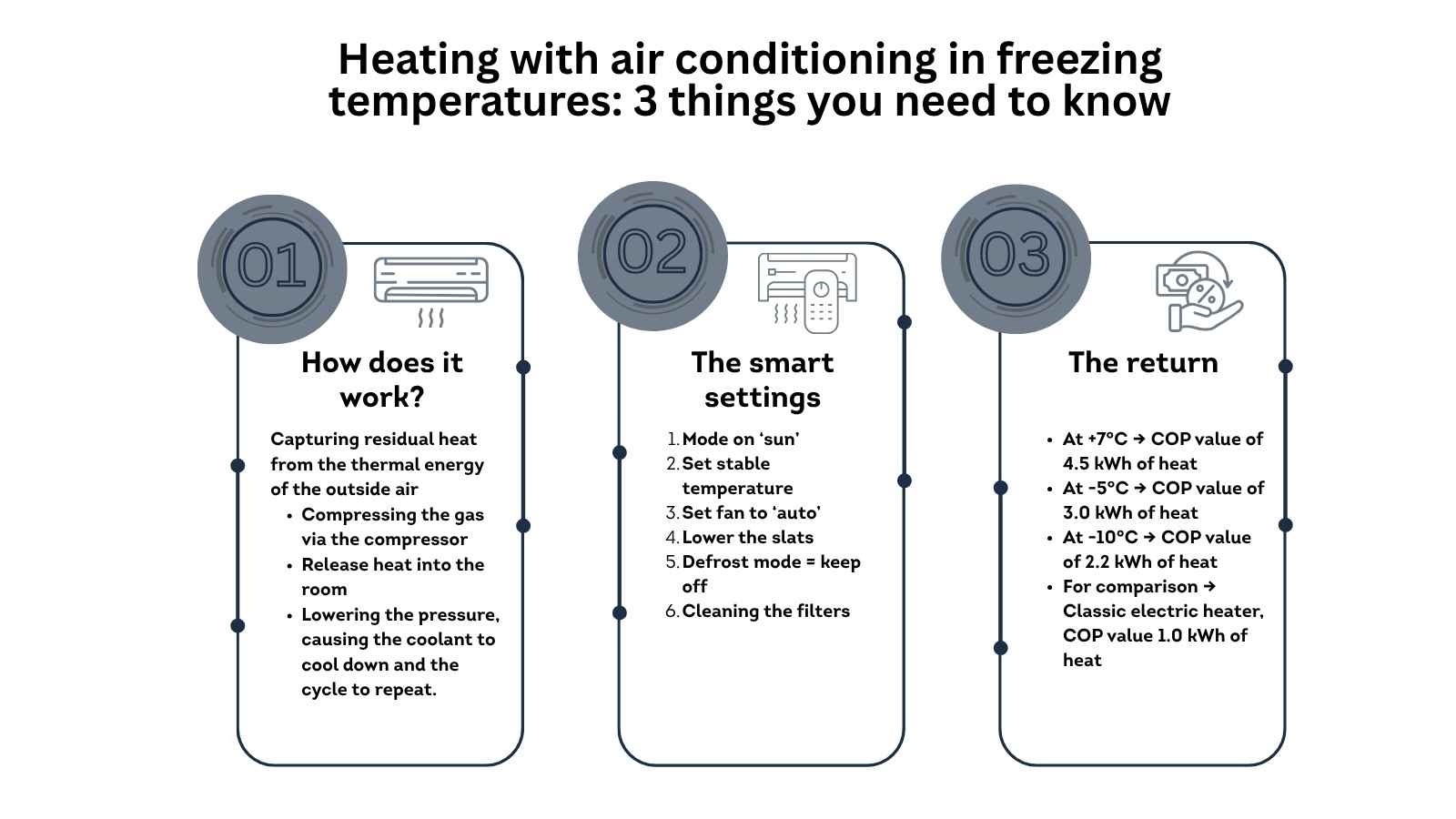
But where does the unit get its heat from when it’s freezing outside? The assumption that there is no heat in the outside air during a freeze is a misconception. Absolute zero—the point at which there is truly no heat left in the air—is not reached until -273°C. So even at severe Belgian winter temperatures of -10°C or -15°C, the outside air still contains usable thermal energy. To extract that heat from the freezing outside air and blow it into your living room, the air conditioning system continuously cycles through a closed loop in four steps.
- Extracting heat via the evaporator: A special refrigerant—which is extremely cold at that moment—flows through the pipes in the outdoor unit. Because this refrigerant is even colder than the outside air and the outdoor temperature, it acts like a magnet for heat. It absorbs the heat present in the freezing-cold outside air, causing it to evaporate into a gas.
- Increasing the temperature with the compressor: This gaseous refrigerant is then directed to the compressor, which compresses the gas under high pressure. The laws of thermodynamics ensure that the compressed gas becomes very hot. You can compare it to the bottom of a bicycle pump, which gets hot when you inflate a tire.
- Heat transfer via the condenser: The compressed, hot gas then flows to the indoor unit in your home. A wall-mounted or floor-standing unit blows the cooler indoor air past the hot circuit. The heat is released into your living space, allowing you to enjoy a comfortable indoor temperature. As the gas releases its heat, it cools down and condenses back into a liquid.
- Reducing pressure in the expansion valve: Finally, the fluid flows through an expansion valve. This component causes the pressure to drop rapidly, causing the refrigerant’s temperature to plummet once again to well below freezing. The ice-cold refrigerant flows back out, ready to start the cycle all over again.
What's the main advantage of this process? You don't generate heat by burning fossil fuels, as you do with a traditional gas or oil-fired boiler It does work, but you’re redirecting and amplifying the natural thermal energy that’s already there for free. That’s exactly what makes heating with an air conditioner such a smart and energy efficient system.
So how should you set the air conditioner when temperatures drop below freezing?
Setting an air conditioner correctly for heating requires a different approach than cooling in the summer. While on a hot summer day you often turn the unit on quickly for immediate cooling, heating in the winter is all about stability, constant air circulation, and intelligently reducing the load on the compressor. Who are air conditioning installation If you set it incorrectly during a freezing night, you risk an unnecessarily high energy bill, a drafty living room, or a system that constantly switches to defrost mode.
To get the most out of your system, you need to consider both the type of unit and the specific settings on your remote control or app.
The Type of Air Conditioning System: Split-Unit vs. Monoblock
Not every air conditioner responds the same way in freezing temperatures. Depending on your living situation, AeroConsult offers two high-quality air conditioning systems to choose from.
- The classic split-unit air conditioner with an indoor and outdoor unit: this is the most common type of air conditioning system. Because the compressor and heat exchanger are located in the outdoor unit, high-quality split-system air conditioners perform effortlessly at temperatures ranging from -15°C to -20°C. It is important, however, that in freezing conditions, the outdoor unit remains free of snow buildup and that the condensate released during the defrost cycle can drain away easily without creating a dangerous patch of ice beneath the unit.
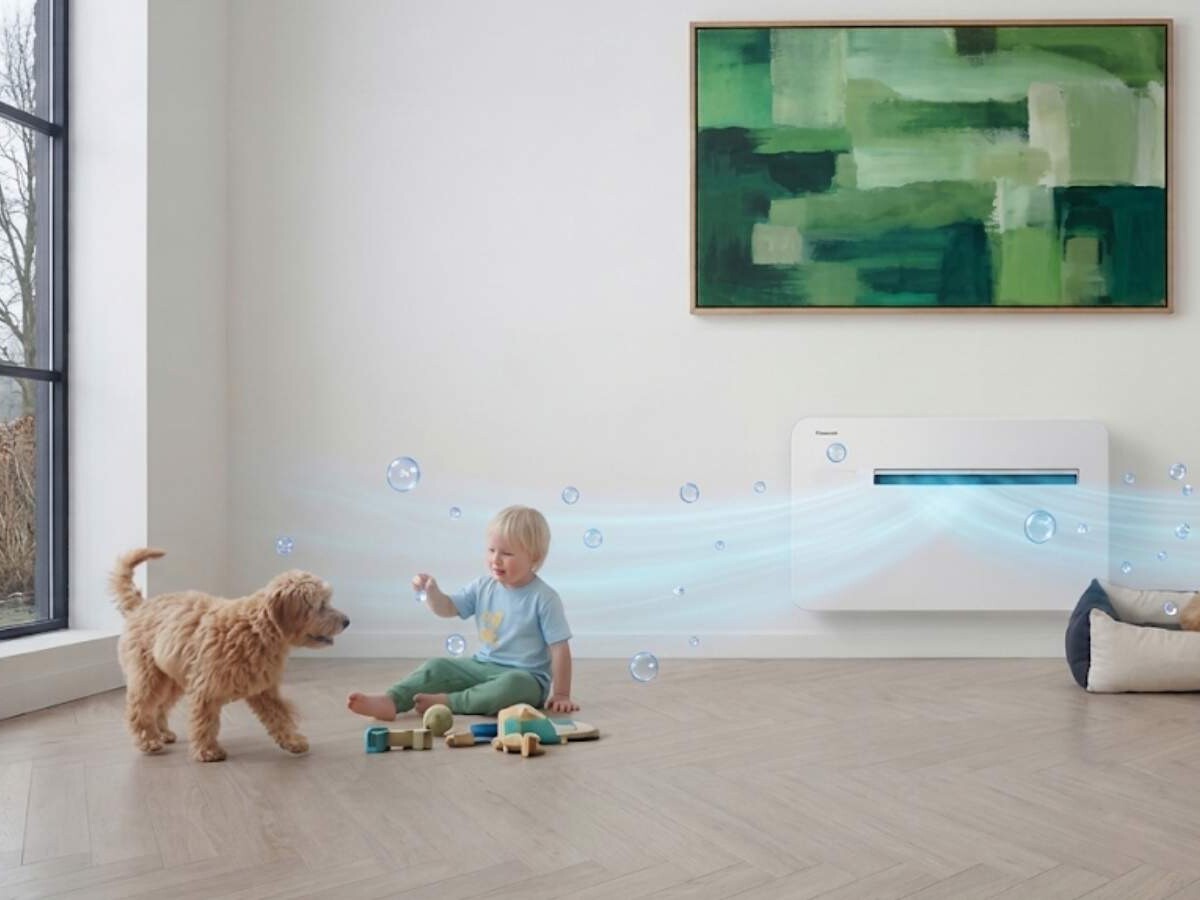
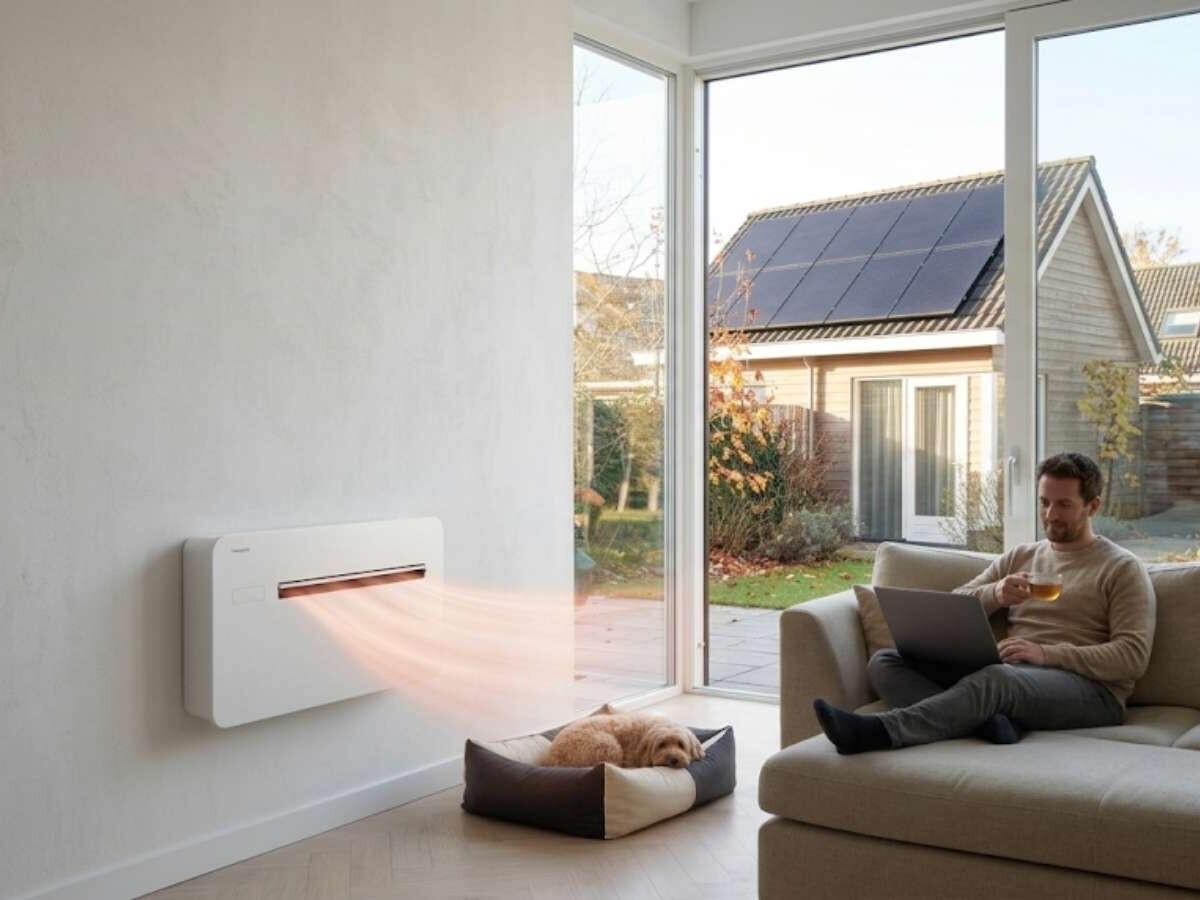
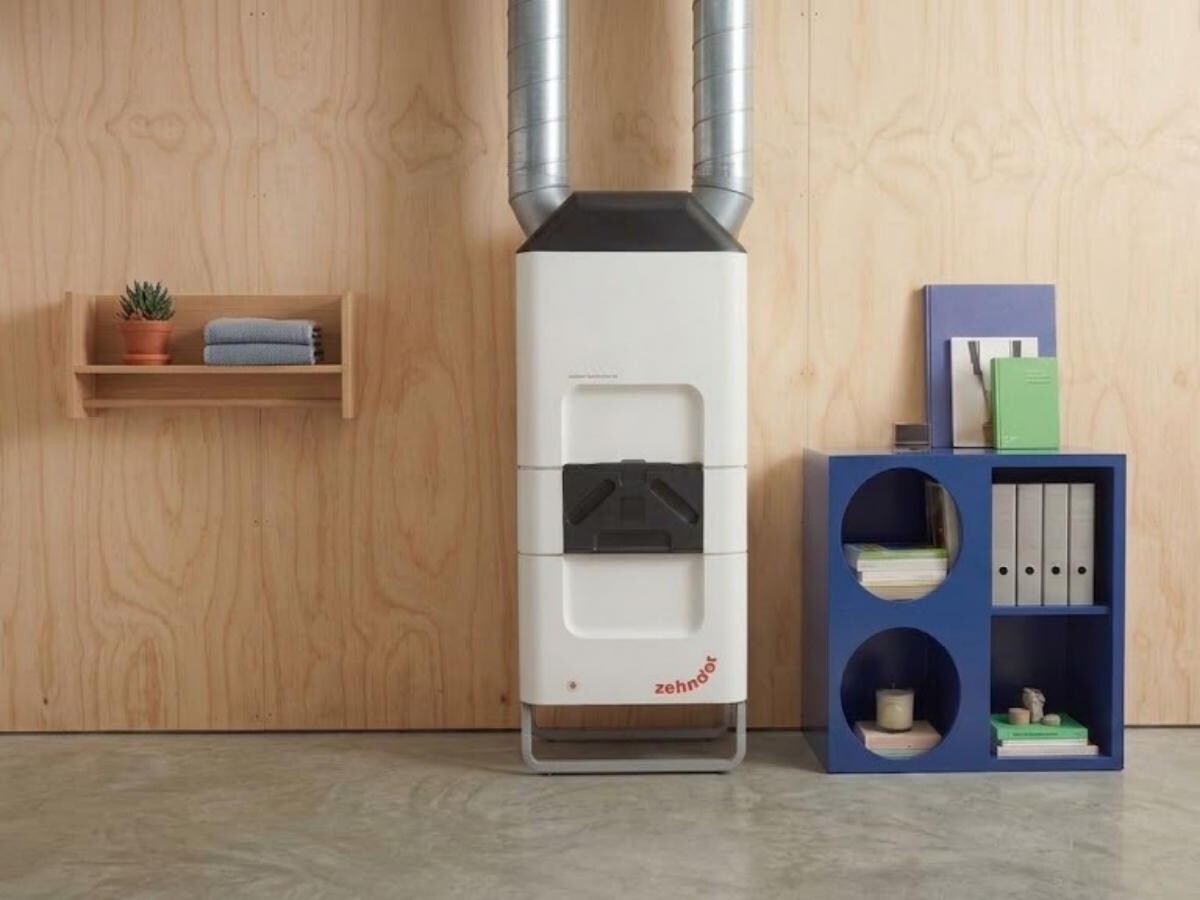
- The modern monoblock air conditioning No outdoor unit: As specialists in monoblock air conditioners, we at AeroConsult prove every day that you don’t need an outdoor unit to keep your home comfortably warm. Two discreet ventilation grilles in the exterior wall are all it takes. Modern monoblock air conditioners feature built-in air-to-air heat pump technology which draws in the freezing cold air and uses it efficiently. In freezing temperatures, it is especially important that the wall penetrations are seamlessly insulated against thermal bridges and that the automatic condensate drain is installed in a frost-resistant manner.
The 6 Best Air Conditioning Settings for Freezing Temperatures
Are temperatures below freezing? With these settings, you'll get the highest efficiency and the best comfort from your air conditioning system.
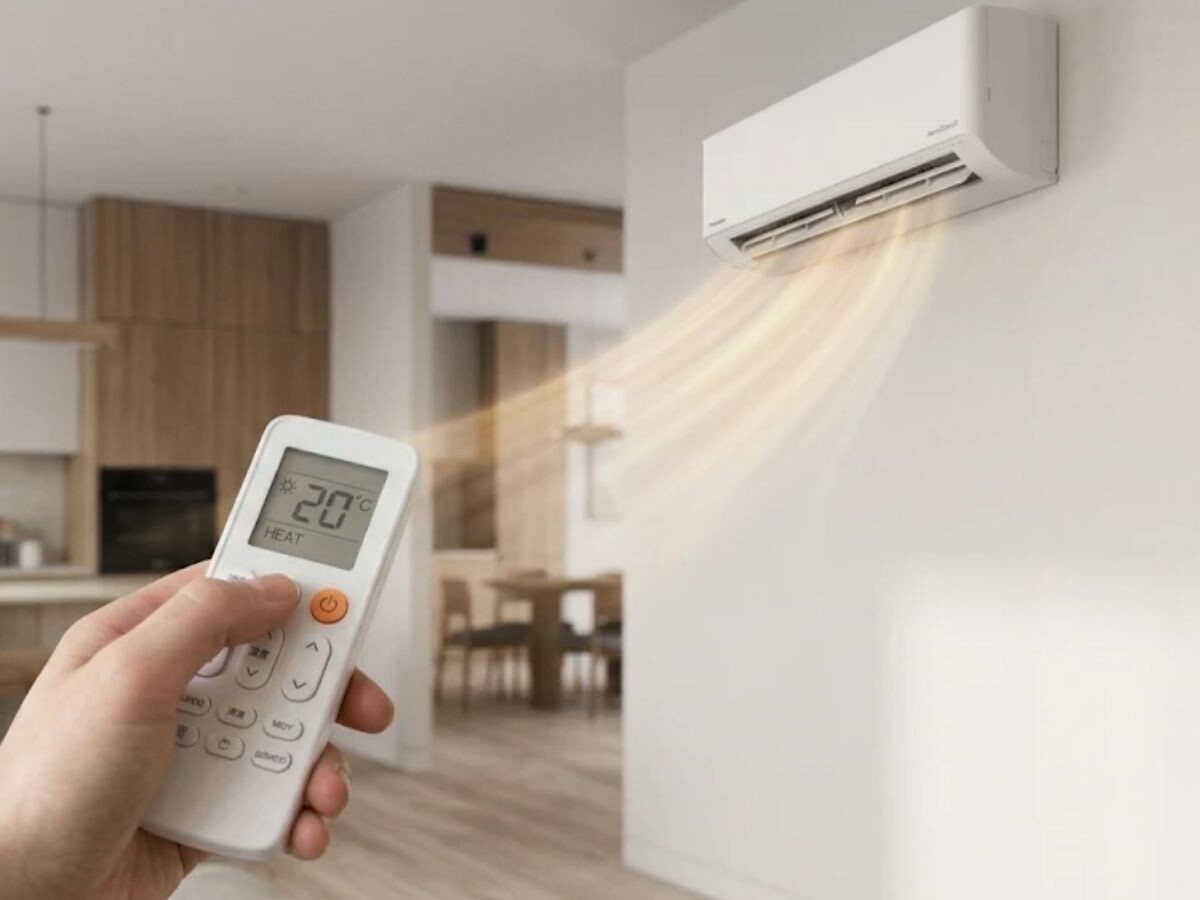
- Always select heating mode or the sun icon manually: never set your air conditioner to automatic mode in the winter. In auto mode, the unit decides on its own whether to cool or heat your home. If, on a cold winter day, the sun shines through your windows and the indoor temperature temporarily rises, an air conditioner in auto mode may suddenly blow cold air into the room to cool it down. That’s why you should always force the heating mode by selecting the sun icon.
- Maintain a consistent target temperature: the biggest energy drain during a freeze is turning the unit off completely when you go to sleep or leave the house. If the house cools down to 14°C, the air conditioner will have to run at maximum power for hours in the morning when temperatures are freezing. That’s also the exact moment when your system’s efficiency is at its lowest. The rule of thumb is to lower the temperature at night by no more than 2 to 3 degrees. This way, the walls and floor retain their temperature, and the inverter compressor only needs to make minor adjustments in the morning.
- Set the fan speed to “auto”: it’s tempting to set the fan to the quietest setting, but in freezing temperatures, this is counterproductive. If the indoor unit cannot release the heat it generates into the room quickly enough, the internal pressure in the air conditioning system rises and the compressor shuts down prematurely. By setting the fan to “auto,” the unit automatically regulates the ideal airflow for optimal heat output.
- Always angle the louvers downward: warm air rises, and cold air sinks. If you set the louvers to blow horizontally in the winter, all the heat will stay near the ceiling while your feet remain cold. Use the remote control to adjust the horizontal louvers so that they direct the warm air toward the floor. The warm air will then spread across the floor and rise evenly throughout the room on its own.
- Do not touch anything during the defrost cycle: If the temperature drops toward freezing and the outdoor humidity is high, the air conditioning system will periodically—approximately every 45 to 90 minutes—start a defrost cycle lasting 5 to 15 minutes. The indoor unit will briefly stop blowing air to prevent drafts in your home; outside, you may see steam rising and sometimes hear a hissing sound. Be sure not to turn off the unit at that moment. If you restart the air conditioner then, you’ll interrupt the process, causing the heat exchanger to freeze over even faster and more heavily.
- Keep the air filters clean: In the winter, the air conditioner runs frequently and for longer periods. Dust on the filters Blockage of the indoor unit’s air outlet hinders the flow of warm air, causing the unit to work harder to release heat into the room. This can reduce efficiency by 10% to 15%. Therefore, check and clean the filters every two to four weeks during the winter using a vacuum cleaner or lukewarm water.
How efficient is an air conditioner in the winter?
People like to boast about the returns from an air conditioning system at a mild outdoor temperature of +7°C. But how does it perform an air-to-air heat pump How does it perform when it's really cold? To determine your air conditioning system's winter performance, our technicians look at four key factors.
- The COP (Coefficient of Performance) value, or the snapshot: this shows the ratio between energy consumption and the heat output at a specific moment. On a mild winter day at +7°C, the COP ranges from 4.0 to 4.8. This means that on this day, 1 kWh of electricity delivers just over 4 kWh of heat. However, at temperatures ranging from 0°C to -5°C, the COP drops to an average of 2.8 to 3.2. And at a temperature of -10°C, the COP remains around 2.0 to 2.5. So even during a bitterly cold night, an air conditioner still produces twice as much heat as a traditional electric heater with a COP of 1.0.
- The SCOP (Seasonal COP) or seasonal average: since temperatures in Flanders do not remain consistently below freezing during the winter, seasonal efficiency is the most important factor. The SCOP calculates the average energy consumption of your air conditioning system over the entire heating season, including defrost cycles and temperature fluctuations. Our high-quality units have a SCOP value between 4.0 and 5.1, with energy efficiency ratings ranging from A++ to A+++. This means that throughout the winter, you’ll get 4 to 5 times more heat from your air conditioner than the cost of the electricity you pay for it.
- Heating capacity in kW in freezing conditions, maintaining output: In freezing weather, not only does efficiency drop, but so does the maximum airflow of your air conditioning system. Cheaper units can lose up to 40% of their output at -7°C. The advanced compressors we install at AeroConsult retain 80% to 90% of their heating capacity at -7°C, ensuring your home stays warm effortlessly even in freezing temperatures.
- TOL (Temperature Operation Limit) or the lower limit: this is the lowest outdoor temperature at which the air conditioning system is guaranteed to continue operating. Modern air conditioning systems have a TOL ranging from -15°C to -20°C. Since these temperatures are very rare in Flanders, you can be sure of comfortable warmth in your home all winter long.
What does this mean for your energy bill?
- Without solar panels: Over the course of an entire heating season, heating with an air conditioner—with a SCOP of 4 or higher—is at least as affordable such as heating with natural gas. Only during those few exceptional days of freezing weather each year is the cost per kWh of heat temporarily slightly higher than that of traditional heating.
- With solar panels: then you're the clear winner when it comes to heating in freezing temperatures. You use the solar energy you generate yourself directly to heat your home during the day. This way, you avoid low feed-in rates and You'll take some of the load off the traditional gas boiler maximum.
Conclusion: An air conditioner is a smart and comfortable choice for winter
Can an air conditioner heat your home when it's freezing outside? The answer is yes. A modern air-to-air heat pump It has long since ceased to be just a summer appliance; it is now a full-fledged, reliable, and efficient heating system that can be used year-round.
With a seasonal efficiency of 4 to 5, you get significantly more heat per kilowatt-hour of electricity in the winter than with any other conventional electric heating system. By keeping the unit running continuously and steadily, directing the airflow downward, and keeping the filters clean, you’ll enjoy maximum comfort at home with minimal operating costs.
Ready for a worry-free winter? Ask yourself free expertise At AeroConsult, we leave nothing to chance. Our experts are happy to visit you anywhere in Flanders for a free, no-obligation consultation. We’ll assess your spaces, calculate the cooling capacity needed for freezing temperatures, and provide you with a clear, customized proposal.
Want to learn more about the benefits of air conditioners? Check out our latest blog posts now.